
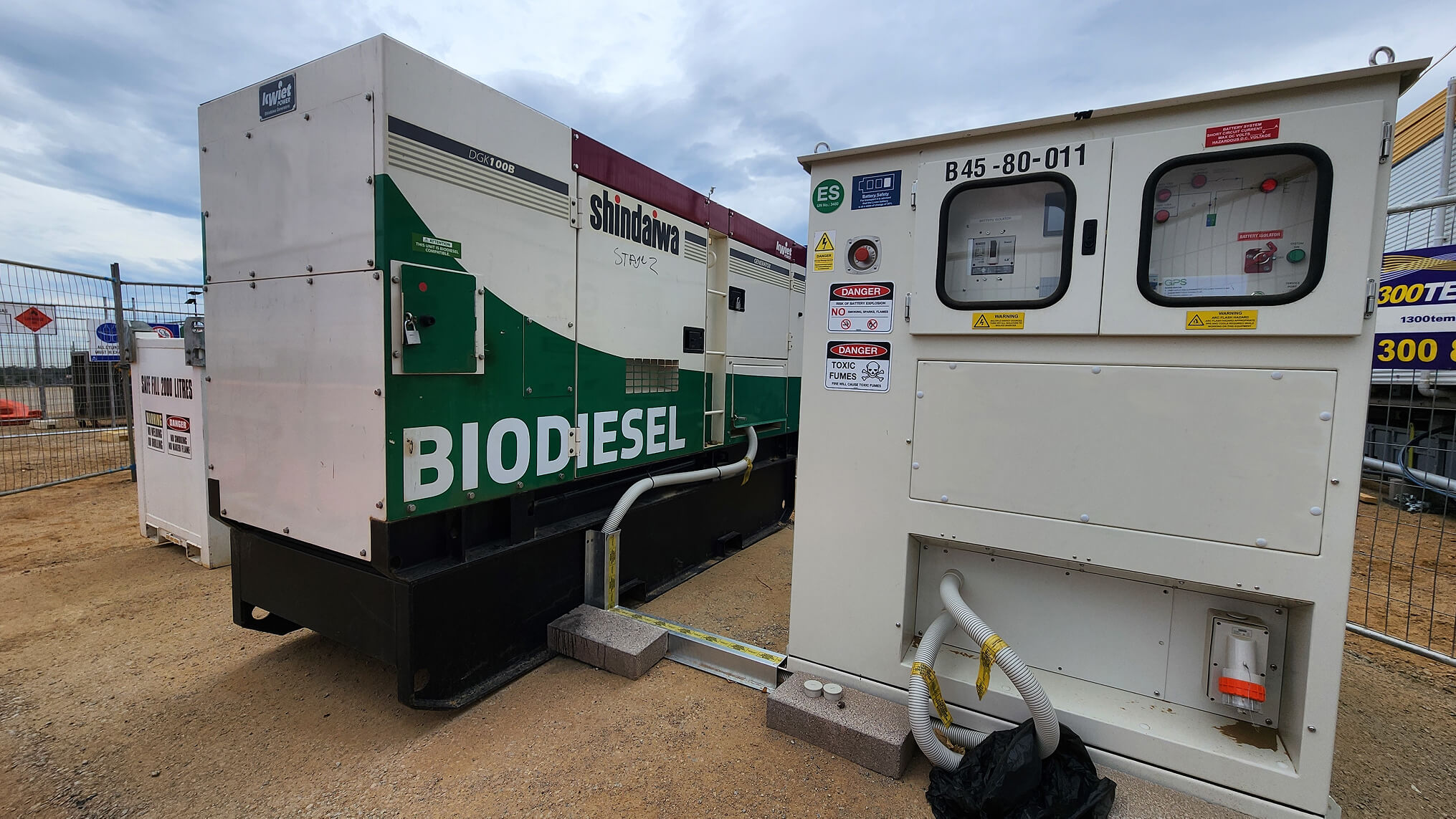
With sustainability targets tightening across construction, mining, infrastructure and events, many Australian businesses are exploring alternatives to traditional diesel power. Biodiesel generators are often labelled as “100% compatible” but what does that actually mean in practical, operational terms?
For project managers, procurement teams and site supervisors, compatibility is not just a marketing phrase. It directly affects reliability, compliance, maintenance planning and overall project risk.
At Green Power Solutions, biodiesel generators are engineered to deliver consistent performance while supporting measurable environmental outcomes. Understanding what “100% compatible” means can help you make informed decisions about integrating biodiesel into your temporary or long-term power strategy.
What does “100% biodiesel compatible” actually mean?
When a generator is described as 100% biodiesel compatible, it means the system has been specifically designed and built to operate on B100 fuel — pure biodiesel — without requiring blending, retrofitting or aftermarket modifications.
This includes:
- Engine components selected to handle biodiesel properties
- Fuel system materials designed for long-term compatibility
- Seals and hoses suited to biodiesel’s chemical characteristics
- Performance testing under Australian operating conditions
In practical terms, this means the generator is not simply “tolerant” of biodiesel. It is engineered to run on it as a primary fuel source.
For Australian worksites operating in harsh weather, remote environments or compliance-heavy sectors, that distinction matters.
What it does not mean
It is equally important to clarify what 100% compatibility does not mean.
It does not mean any standard diesel generator can automatically run on B100. Many conventional units are designed for mineral diesel or low-level biodiesel blends only. Using high blends in incompatible equipment can create long-term performance issues.
It also does not remove the need for proper fuel quality management. Biodiesel, like any fuel, must be stored, handled and monitored correctly to maintain performance.
And it does not eliminate maintenance. Regular servicing, monitoring and load management remain critical to ensuring uptime and longevity.
Compatibility reduces risk. It does not remove operational discipline.
Why compatibility matters on real Australian sites
Across Australia, power reliability is non-negotiable.
On construction sites, equipment downtime can delay schedules and increase costs. In mining operations, remote locations demand dependable systems that meet strict regulatory requirements. For critical infrastructure such as data centres or healthcare facilities, backup power must activate seamlessly.
A generator engineered for biodiesel compatibility provides:
- Consistent combustion performance
- Stable engine operation
- Reduced carbon emissions compared to petroleum diesel
- Confidence that fuel choice will not compromise uptime
For urban construction zones and public-facing events, biodiesel generators also support environmental targets and community expectations around cleaner operations.
When paired with silent or low-noise models, they can help maintain compliance in residential or noise-sensitive areas.
Compatibility and hybrid integration
Modern temporary power is evolving beyond standalone generators. Hybrid battery energy storage systems are increasingly being used to reduce runtime, lower fuel consumption and minimise emissions.
Biodiesel-compatible generators integrate smoothly into hybrid setups. In low-demand periods, batteries carry the load. When demand increases, the generator starts and runs efficiently under optimal load conditions.
This approach reduces low-load running, improves fuel efficiency and limits unnecessary emissions. It also enhances overall system performance and extends equipment life.
For projects aiming to reduce fuel burn while maintaining reliability, biodiesel compatibility is an important piece of the hybrid equation.
Supporting compliance and sustainability goals
Australian businesses are under increasing pressure to demonstrate environmental responsibility. ESG reporting requirements, Scope 3 emission targets and procurement frameworks are becoming standard across many sectors.
Biodiesel generators offer measurable environmental advantages, including reduced lifecycle greenhouse gas emissions compared to conventional diesel.
In environmentally sensitive areas such as marine environments, agricultural regions or national parks, biodegradable and lower-toxicity fuel options provide additional reassurance.
For organisations seeking to align operations with sustainability commitments, biodiesel-compatible systems can form part of a broader emissions reduction strategy without requiring wholesale infrastructure changes.
Is biodiesel compatibility right for every site?
For many Australian industries, the answer is yes – but implementation must be strategic.
Successful integration depends on:
- Correct generator sizing
- Accurate load assessments
- Appropriate fuel storage and supply planning
- Ongoing monitoring and servicing
A well-matched generator running at the correct load profile will always outperform an oversized or poorly managed system, regardless of fuel type.
That is why biodiesel compatibility should be viewed as part of a complete power solution, not simply a fuel switch.
The bottom line
“100% biodiesel compatible” is more than a label. It means the generator has been purpose-built to operate on B100 fuel reliably, safely and efficiently.
For Australian worksites facing increasing environmental expectations without any tolerance for downtime, that compatibility provides confidence. It supports cleaner combustion, measurable emissions reduction and seamless integration with hybrid systems, all while maintaining operational performance.
When selected, sized and managed correctly, biodiesel generators deliver a practical balance of reliability and sustainability.
For businesses seeking to power construction projects, remote operations or critical infrastructure responsibly, understanding compatibility is the first step toward building a resilient, future-focused energy strategy.